People as partners in data systems
Engagement belongs throughout the lifecycle
Registries and health information systems influence which questions are asked, which outcomes are visible and how evidence is used. CHIEF therefore examined how people living with non-communicable diseases can help shape these systems, using diabetes as a practical example. Participation is relevant not only when data are collected, but also when priorities, governance, interpretation and communication are decided.
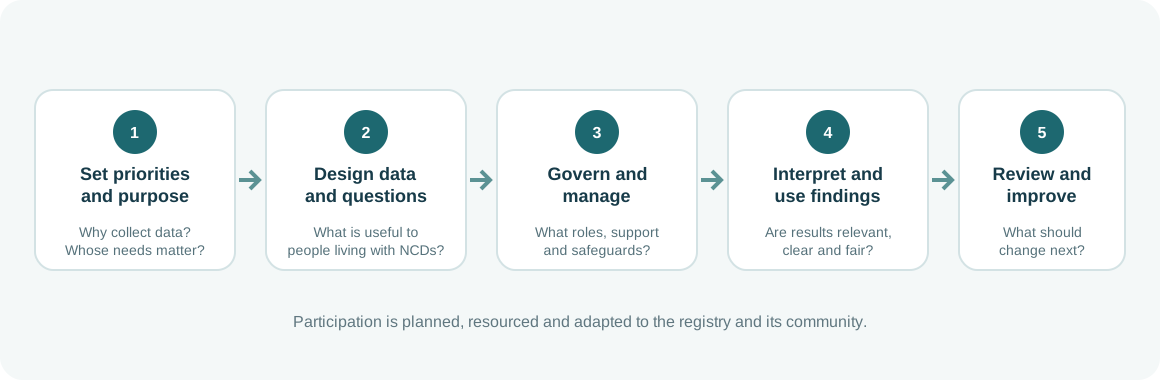
Patient-reported outcome and experience measures can describe important aspects of health and care, but they are not a substitute for participation in setting priorities or governing a registry. A data system that is designed only around professional and administrative requirements can miss quality of life, treatment burden, access to support, self-management needs and trust in how information is used.
The CHIEF activity drew on published and grey literature, country reports and consultations. Reports were received from Croatia, Belgium, Hungary, Latvia, Malta, Poland, Scotland, Slovenia and the Netherlands. Discussions also took place through International Diabetes Federation meetings, a joint IDF Europe and WHO Europe meeting, EASD/EUDF activity and the Global Parliamentary Forum. Across these sources, engagement was recognised as important, while systematic and documented roles for people with diabetes in registry design and management were not consistently evident.
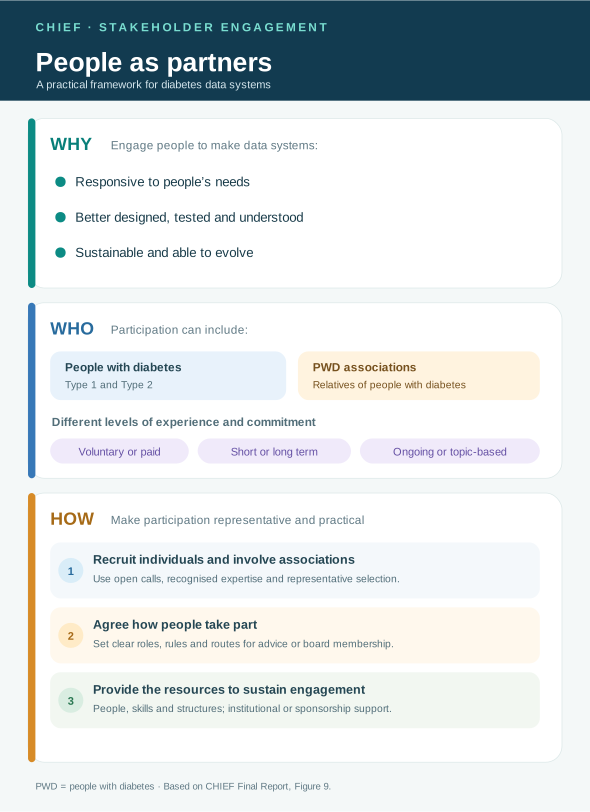
Why, who and how
A meta-method, not a single template
CHIEF proposes three questions to help a local team plan involvement:
- Why: what purpose should participation serve? The report includes defining needs and benefits, identifying useful features, contributing to design, evaluating whether the system works for people, validating its functions, disseminating findings and sustaining its development.
- Who: which people and organisations should be involved? This includes individuals with a condition, patient associations, relatives or carers where appropriate, and people with different levels of experience, commitment and representation. A formal association may be important, but does not automatically represent everyone affected.
- How: what roles, resources and arrangements make participation meaningful? Recruitment may take place through self-nomination, public calls, associations or institutional channels. Teams need to consider time, accessibility, support, duration, compensation and the decision-making role offered to participants.
The questions are designed to be adapted to the local context rather than copied as a universal checklist. Registry ownership, clinical integration, language, digital access, legal conditions, available resources and the capacity of community organisations all affect what is feasible. Representation also requires attention to people who may otherwise be missed, including those facing disability, language or socioeconomic barriers.
From consultation to participation
Make roles visible and reviewable
The activity identifies practical obstacles: difficulty locating suitable participants, uncertainty about the role people with a condition should hold, limited time for coordination, and insufficient resources to support sustained participation. When the remit is unclear, consultation can remain occasional and have little influence on priorities or decisions. A well-defined process should state what participants can shape, when they will be involved, how their input will be considered and how feedback will be returned.
The proposed CHIEF checklist is intended to help teams design engagement into the development and operation of data collection systems. It can be used to consider participation in governance, indicator selection, interpretation, communication and evaluation. The checklist is flexible by design: local questions can be added, tested with the community and revised as experience grows. This allows approaches to be compared across settings without assuming they must all be identical.
Related manuscript
Patient involvement in chronic disease registries
- Massi-Benedetti M, Michael CM, Carinci F, Cunningham S, Dimnjakovic J, Poljicanin T, Štotl I, Nicholson N, Dupont E. Patient involvement in chronic disease registries: a narrative review and roadmap for the implementation of participative European data platforms. Submitted, 2026.
References
Selected references
- Armocida B, Tolonen H, Rakovac I, et al. Strengthening non-communicable diseases monitoring systems in Europe through a multistakeholder collaborative approach. The Lancet Regional Health – Europe. 2025;61:101553. doi:10.1016/j.lanepe.2025.101553.
- Borg S, Eeg-Olofsson K, Palaszewski B, et al. Patient-reported outcome and experience measures for diabetes. BMJ Open. 2019;9:e025033. doi:10.1136/bmjopen-2018-025033.
- Carinci F, Nicholson N. Linking registries to deliver standardised NCD indicators in the European Health Data Space: why do we need CHIEF? Frontiers in Public Health. 2025. doi:10.3389/fpubh.2025.1684947.