CHIEF data field test · REWINDER
Testing contextualised NCD data in a local information system
The field test applied the CHIEF approach to the data of the Romagna health care authority collected for the REWINDER project, thanks to the active participation of Prof. Paolo Di Bartolo, Coordinator of REWINDER and Head of the Diabetes Care Program, AUSL Romagna. The test examined how population records, hospital data and diabetes-clinic measurements can be prepared as privacy-preserving aggregate context for non-communicable disease indicators. The guide describes the Aggregate Contextualisation Package, its inputs, the analytical boundary, target populations, outputs and quality checks.
1 · Purpose and analytical boundary
Contextualisation starts after indicator definitions
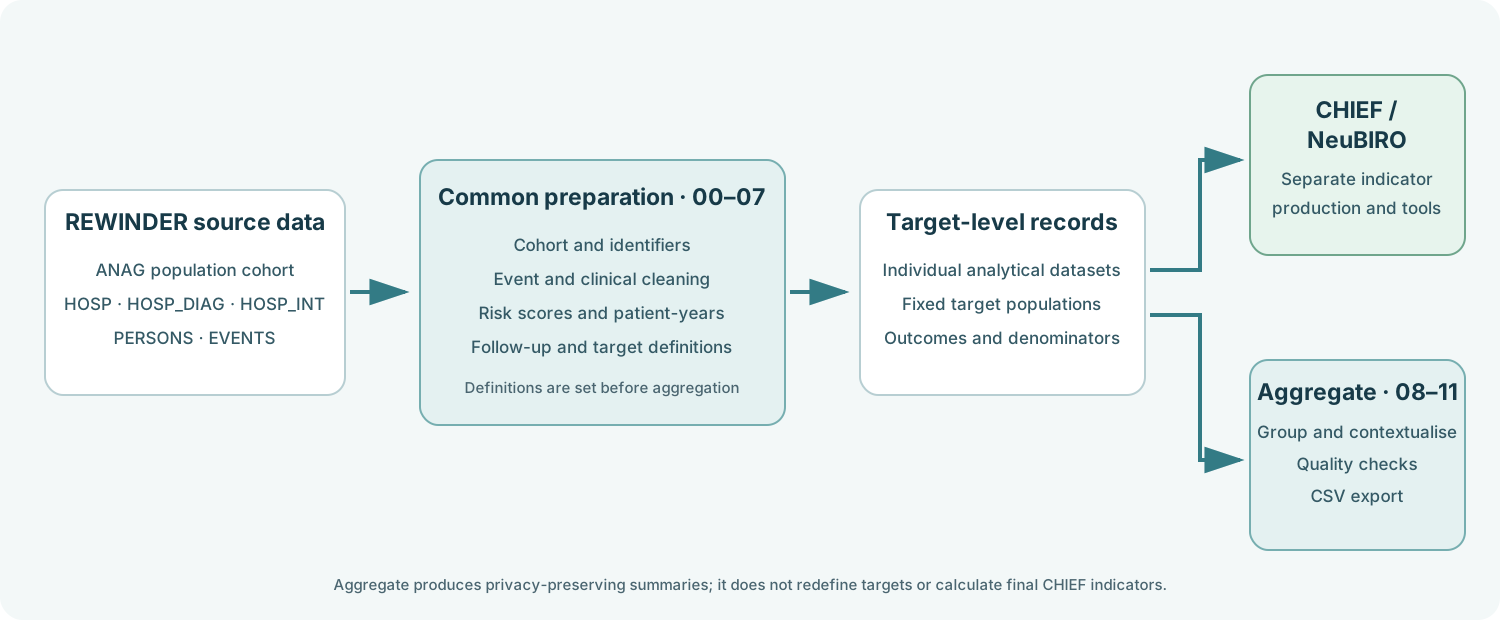
The package does not calculate the proposed core CHIEF indicators. The common preparation layer first constructs the cohort, cleans clinical and event histories, builds person-period records and applies the epidemiological definitions for each target. It produces canonical individual analytical datasets with target-specific eligibility, events and denominators. Aggregate begins only after those definitions have been applied: its modules group the records, calculate contextual summaries, run structural checks and export aggregate files.
This boundary prevents the aggregation layer from reimplementing indicator definitions. The package is operationally separate from the subsequent production of CHIEF indicators and from NeuBIRO preparation, even though all three can use the same canonical target-level records. The REWINDER source data and person-level outputs remain within the controlled local environment; the package exports summary cells without patient identifiers.
2 · Sources and cohort
Population and clinical records serve different purposes
The population cohort is based on the ANAG register of people with diabetes in the AUSL Romagna area. It supplies diagnosis year and vital status. Linked hospital datasets (HOSP, HOSP_DIAG and HOSP_INT) contribute diagnoses and procedures for longitudinal population outcomes. PERSONS identifies people receiving care in the diabetes clinics; EVENTS contains their repeated clinical measurements. These sources complement, rather than replace, the wider population cohort.
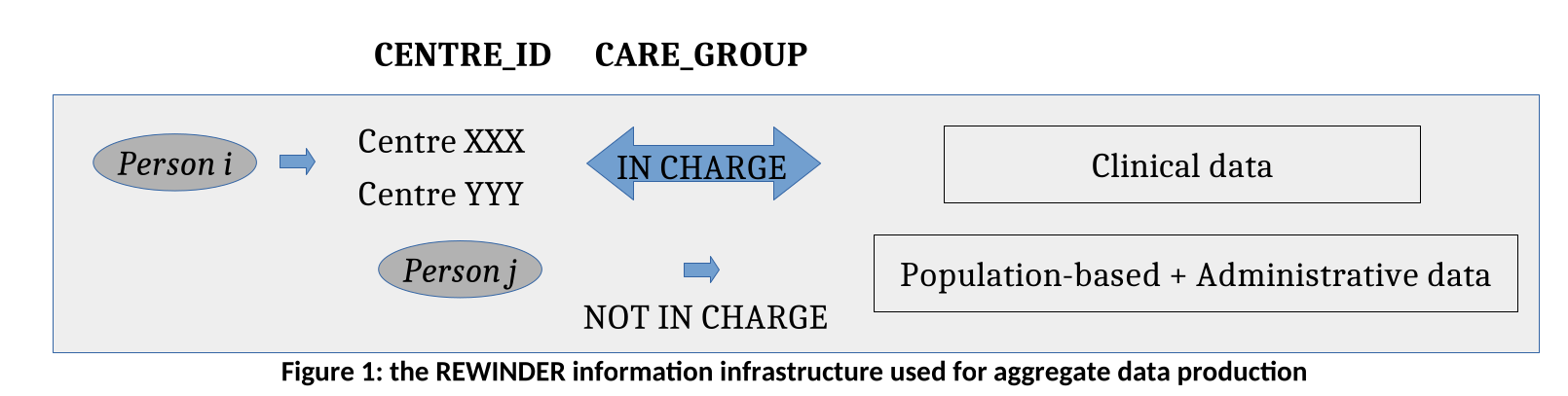
The reference baseline is 1 January 2019, with six years of follow-up through 2024. People with valid clinic measurements are described in the guide as “in charge”; people represented by annual records from other health services but without current clinic measurements are “not in charge”. A PERSONS record without a valid clinical centre is excluded from the clinical source, but that does not remove the person from ANAG or the population-level macro cohort. This preserves a broad population denominator while requiring an attributable provider for centre-specific clinical outputs.
Figure 2 in the source guide illustrates the distinction: people linked to a CENTRE_ID are associated with clinic data, while the population-and-administrative-data pathway can also represent people not currently in charge. The two aggregate dimensions are therefore intentionally different.
3 · Cleaning and person-period measures
Repeated measurements are reduced to annual records
Before aggregation, the common layer handles malformed source codes, implausible values, explicit missing values and repeated observations. Clinical measurements are cleaned and translated into person-year summaries. For each person i and year y, all valid HbA1c readings contribute to the annual mean; the “last HbA1c” is selected separately as the chronologically most recent valid reading. The two measures describe different aspects of glycaemic status and are not interchangeable.
Annual mean HbA1c
H̄i,y = (1 / mi,y) × ∑j=1mi,y Hi,y,j
All m valid readings during the year are used.
Last annual HbA1c
Hi,y,last = Hi,y,j*, where date(j*) = max date(j)
The most recent valid reading is selected by date within that year.
Blood pressure and body-mass index are also cleaned and summarised for contextual description; relevant lifestyle and risk inputs are carried through where available. No clinical contextual measure changes the upstream target definition merely because it is present or absent.
4 · Grouping and indicator families
Macro outcomes use care groups; clinical measures use centres
Each aggregate row is defined by its target, analysis period, reporting unit and contextual pattern. The macro/micro distinction determines the reporting unit before aggregation. CARE_GROUP is a fixed baseline grouping for population outcomes; CENTRE_ID is imported from the clinical source for centre-level measures and is not inferred from whether HbA1c is available.
| Family | Reporting unit | Targets represented in the guide |
|---|---|---|
| Population / macro | CARE_GROUP | Baseline case mix; all-cause mortality; first major amputation; retinopathy at diagnosis; 2019 diabetes prevalence |
| Clinical / meso-micro | CENTRE_ID | Mean HbA1c >7.5%; last HbA1c >7.5%; SCORE2-Diabetes >10% |
Categorical contextual variables include sex, diabetes type, baseline age class and baseline diabetes-duration class. Continuous cell summaries include HbA1c, systolic and diastolic blood pressure, and BMI; classes derived from their cell means are also retained. These cell means describe case mix. They are not estimates of patient-level category prevalence and do not constitute a fitted risk-adjustment model.
5 · Denominators and reported quantities
Eligibility, observation and events stay separate
For a target, reporting unit c and period y, N_RISKSET is the eligible population after the target’s inclusion, exclusion and prior-event rules. N_AT_RISK is the subset with observed outcome status (the export field retains this historical name); N_MISSING counts eligible records without observed outcome status. Among observed records, EVENTS and NON_EVENTS partition the denominator.
Denominator accounting
NRISKSET = NAT_RISK + NMISSING
NAT_RISK = EVENTS + NON_EVENTS
Completeness and crude proportion
COMPLETENESS (%) = 100 × NAT_RISK / NRISKSET
EVENT_RATE (%) = 100 × EVENTS / NAT_RISK
The event proportion is calculated among people with observed status. Completeness shows how much of the eligible group has observed status. They answer different questions and should be read together. Missing records are never silently recoded as non-events. These annual outputs are crude discrete-time proportions, not person-time incidence rates.
6 · Target-specific follow-up
Eligibility rules follow each outcome
- All-cause mortality: each year’s risk set contains people alive at its start; a death in that calendar year is counted in the year of death, and people who died earlier contribute no later years. Vital status is expected to be observed, so mortality missingness is expected to be zero.
- Major amputation: a first-event risk set is used. A person contributes through the first event year and is excluded from later years for this outcome. Missing status in one year remains missing for that year and does not automatically censor all later years.
- Retinopathy at diagnosis: the guide specifies a fixed cohort of people diagnosed in 2017–2019 and pooled ascertainment across 2019–2020, de-duplicated by person and represented once at baseline.
- Mean and last HbA1c >7.5%: annual, non-censoring outcomes. The observed denominator requires at least one usable annual HbA1c; no usable measurement contributes to missingness rather than being treated as controlled.
- SCORE2-Diabetes >10%: annual and non-censoring among people with a calculable score. The aggregate file also describes the continuous score distribution.
The first-event time Ti for major amputation determines the outcome-specific contribution: a person remains in the risk set while y ≤ Ti; if no event is observed, follow-up continues under the remaining eligibility rules. Censoring is target-specific, so a person can remain eligible for one outcome after leaving another outcome’s risk set.
7 · SCORE2-D and contextual summaries
Keep the high-risk flag beside its distribution
The SCORE2-D output includes the binary high-risk indicator (>10%) and descriptive summaries of the continuous score: number calculable, mean, median, 25th percentile and 75th percentile. Keeping these together shows how the binary threshold relates to the underlying distribution. The guide explicitly treats the current implementation as a software and descriptive test: eGFR values were unavailable in the REWINDER extraction, so severe target-organ-damage exclusions could not be fully implemented. It must not be presented as a fully validated clinical risk-score implementation.
Other continuous values are summarised within the aggregate cell. HbA1c, SBP, DBP and BMI means may be accompanied by classes derived from those means. Lifestyle/context variables are carried through where available. These contextual fields support interpretation of local variation, but they do not adjust the final indicator estimates by themselves.
8 · Exported datasets
Eight output files preserve target-specific summaries
-
baseline_indicator.csvBaseline case-mix distribution by CARE_GROUP. -
major_amput_indicator.csvAnnual major-amputation risk sets and events. -
retino_indicator.csvRetinopathy at diagnosis for the specified diagnosis cohort and window. -
mean_hba1c_indicator.csvAnnual mean HbA1c >7.5% by CENTRE_ID. -
last_hba1c_indicator.csvAnnual last HbA1c >7.5% by CENTRE_ID. -
score2d_indicator.csvSCORE2-D >10% counts and continuous distribution by CENTRE_ID. -
mortality_indicator.csvAnnual all-cause mortality contextual cells by CARE_GROUP. -
diabetes_prevalence_2019.csv2019 crude prevalence tabulated by sex and age stratum.
The prevalence reference file supplies the local 2019 sex-age population denominator. Direct OECD age-sex standardisation belongs to the separate CHIEF indicator production process, not this Aggregate package.
Crude diabetes prevalence
PREVALENCE (%) = 100 × NDIABETES / NPOPULATION
Calculated for the corresponding 2019 sex-age population stratum.
9 · Quality checks and interpretation
Reconcile counts before interpreting differences
Quality control checks that macro records carry CARE_GROUP, centre-level clinical records carry a valid CENTRE_ID, and each exported record matches its target’s intended grouping and follow-up. It also verifies the denominator identities, event bounds, completeness range and the expected zero mortality missingness. The deployment outputs and reference files must contain no patient identifiers.
N_RISKSET = N_AT_RISK + N_MISSING
N_AT_RISK = EVENTS + NON_EVENTS
EVENTS ≤ N_AT_RISK
0 ≤ COMPLETENESS ≤ 100
Outputs are descriptive contextual statistical objects, not causal estimates or fully adjusted effects. Differences between cells can reflect case mix, data capture, coding, follow-up, clinical practice and outcome differences. Completeness should accompany the event proportions. Broad contextual age classes must not be confused with the OECD age-sex standardisation cells used in CHIEF indicator production.
Source: REWINDER / CHIEF User Guide for the Aggregate Contextualisation Package, version 3 (2026). The guide identifies the package as a local AUSL Romagna field test and notes that individual records remain in the restricted REWINDER environment.